
Publisher: Springer-Nature, 2026.
ISBN 978-981-95-5218-4
This book discusses how Artificial Intelligence (AI) and Internet of Things (IoT) technologies can be utilized to optimize orchard production, management, and conservation to achieve sustainable agriculture development goals. To achieve sustainable development of the next generation of agriculture, it is essential to use modern technology tools to enhance orchard production efficiency, improve fruit quality, and promote intelligent orchard management. Recent developments in AI and IoT are featured in the book, providing solutions to primary orchard and horticultural challenges such as pest and disease management, weed control, and canopy management. As climate change continues to pose challenges to agriculture, highly affecting temperature fluctuations and changes in rainfall patterns, the book offers innovative solutions to enhance productivity, sustainability, and resilience in farming operations. By leveraging AI and IoT, the book seeks to empower the agriculture industry with the tools and strategies needed to adapt to changing environmental conditions and optimize resource use.
The intersection of AI, IoT, and agriculture is a critical focus in the current era, where food security, climate change, and sustainability are top global priorities. With the agricultural sector facing unprecedented challenges due to changing climate conditions, the integration of advanced technologies offers a pathway to resilience and sustainability. This book is timely as it addresses the urgent need for innovation in agriculture, providing actionable strategies to help farmers and agricultural managers navigate the complexities of modern farming while safeguarding the environment. This publication is particularly important now, as it contributes to the broader discourse on how technology can support sustainable development goals and ensure a stable food supply for the growing global population.
AI × IoT: Smart Automation Systems for increasing Agricultural Productivity to Achieve SDGs and Society 5
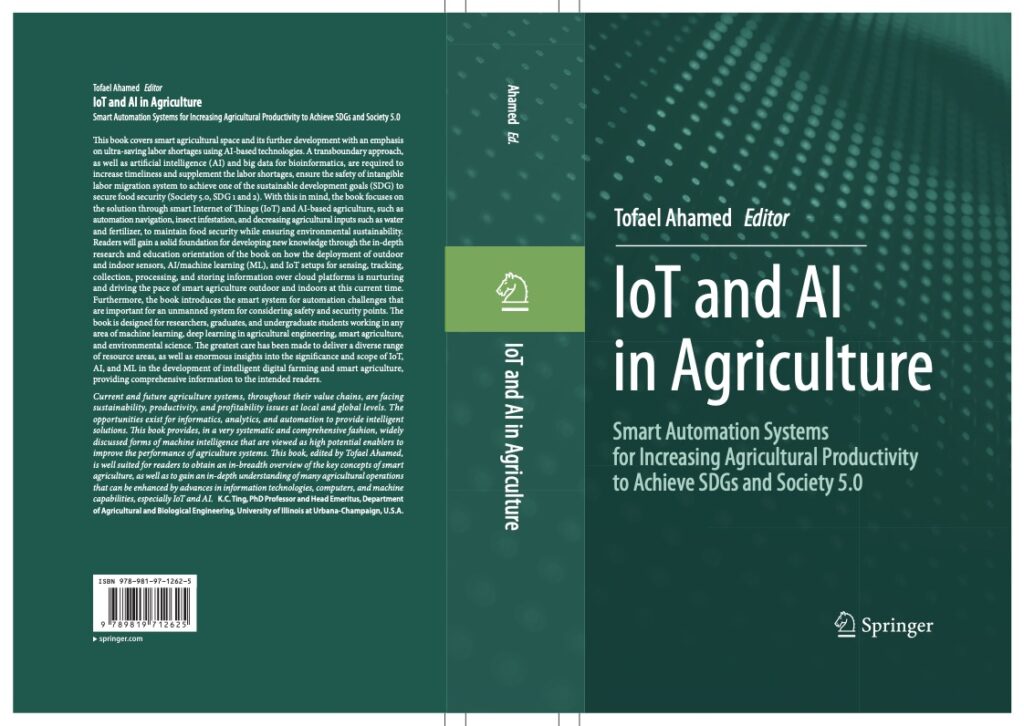
Tofael Ahamed (Editor)
This book covers smart agricultural space and its further development with an emphasis on ultra-saving labor shortages using AI-based technologies. A transboundary approach, as well as artificial intelligence (AI) and big data for bioinformatics, are required to increase timeliness and supplement the labor shortages, ensure the safety of intangible labor migration system to achieve one of the sustainable development goals (SDG) to secure food security (Society 5.0, SDG 1 and 2). With this in mind, the book focuses on the solution through smart Internet of Things (IoT) and AI-based agriculture, such as automation navigation, insect infestation, and decreasing agricultural inputs such as water and fertilizer, to maintain food security while ensuring environmental sustainability. Readers will gain a solid foundation for developing new knowledge through the in-depth research and education orientation of the book on how the deployment of outdoor and indoor sensors, AI/machine learning (ML), and IoT setups for sensing, tracking, collection, processing, and storing information over cloud platforms is nurturing and driving the pace of smart agriculture outdoor and indoors at this current time. Furthermore, the book introduces the smart system for automation challenges that are important for an unmanned system for considering safety and security points.
The book is designed for researchers, graduates, and undergraduate students working in any area of machine learning, deep learning in agricultural engineering, smart agriculture, and environmental science. The greatest care has been made to deliver a diverse range of resource areas, as well as enormous insights into the significance and scope of IoT, AI, and ML in the development of intelligent digital farming and smart agriculture, providing comprehensive information to the intended readers.